A story set two years before the events of The Janus Protocol
— — —
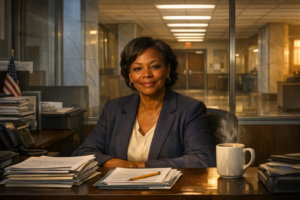
Pat King claimed the seventh floor before the building fully woke up.
Charles at the security desk got a real greeting on her way in. Not a badge flash, not a nod, a real one. She already knew his wife had finished her second round of chemo and was doing better, and she said so, and meant it, and Charles’s whole face changed the way faces do when someone asks the right question.
She carried that warmth up to the seventh floor.
Her day had started, as it always did, at the Sugar & Spice Café in Anacostia, a world away from the marble chill of VA Central Office headquarters. Flyers for church fundraisers and jazz nights covered the walls. The owner asked about her Mama. Greetings took longer than transactions. She held that warmth close on the Metro the way you hold something fragile in a crowd, and brought it through the building’s early yawn like something the place hadn’t earned but needed anyway.
By the time she reached her desk at VACO, she had a better read on the building’s mood than any official report would give Mike Sanders until nine o’clock.
Mike was her boss, a VA senior IT director for one of the largest, most complex technology organizations in the federal government. Serving eighteen million veterans. Sixteen hundred locations. Something always breaking somewhere. He was already in when she arrived; she could tell by the light under his door and the quiet of a man three problems into his morning before most people had found their coffee.
She brewed a fresh pot, laid out his schedule, set a sharpened pencil on the stack of papers by his keyboard, and left him to it. He wouldn’t surface for a while. That was fine. She had work of her own.
— — —
The new one was having a hard morning.
Christopher Harding had arrived at VA three months ago from the US Digital Service with a reputation that preceded him down the hall like a weather system. Talented, the kind Mike had recognized on sight and immediately began channeling into problems that mattered. In Chris’s first six weeks, Mike had handed him three projects, each harder than the last. In Mike’s language, that was the highest compliment available. He invested in talent through mission, not relationship. He handed Chris problems the way a good coach hands a promising athlete the ball in the fourth quarter: without ceremony, without explanation, with complete expectation of delivery.
Chris had delivered every time.
But the building itself hadn’t handed Chris anything yet. The building was watching.
Pat had seen this before. USDS engineers arrived with technical brilliance, genuine idealism, and the outsider’s distance that the career civil servants could detect from two floors away. It wasn’t arrogance in Chris’s case; she’d clocked that immediately. He was earnest. The kind of young man who stayed late not to be seen staying late but because the problem was still open and that bothered him. He believed that better technology made better government made better lives for veterans. Pat respected that. She respected it completely.
But he moved through the seventh floor the way people move through airports: purposefully, efficiently, without interest in what the place was made of or who had been holding it together since before he arrived. He knew Pat’s name. He knew she was Mike’s EA. He understood that she was helpful, reliable, and good at her job.
That was the whole of what he knew about her.
Pat didn’t hold it against him. She just noted it and filed it quietly away.
— — —
Dorothy Simmons had worn a contractor badge for fifteen years.
The building ran on two kinds of people, and most newcomers only ever saw one kind. The first had government badges, civil servants, political appointees, senior executives. The org chart people.
The second kind had contractor badges, a different color stripe, barely distinguishable at a glance but different enough that the building’s long-timers could spot it across a room. Staff augmentees. Butts in seats, in the frank language of the contracting world. They sat at the same desks, attended the same meetings, learned the same systems, carried the same institutional knowledge—sometimes more of it, having worked the same programs for a decade while the civil servants rotated in and out around them.
Until the contract ended. Then they vanished. Not transferred, not retired with a party and a plaque. Just gone, their badges deactivated, their names scrubbed from the directories, their knowledge walking out the door into a Beltway firm or a home office in the area where nobody from the VA ever thought to call.
The building forgot them almost immediately. Pat never did.
Dorothy had worked on some of the VA’s most critical legacy systems, the kind of foundational, unglamorous code that nobody mentioned at leadership offsites but that quietly kept the benefits flowing and the records moving and the whole vast enterprise from grinding to a halt. Present every day. Indispensable. Unnamed in any official account of how the place worked.
She had also brought homemade pound cake to every all-hands meeting for as long as Pat could remember. And once, in a quiet hallway between back-to-back meetings, she spent forty minutes telling Pat about her granddaughter’s first steps, her whole face lit up like sunshine in the morning.
When Dorothy’s contract ended and she retired, Pat called to congratulate her.
That was the only reason she still had the number.
— — —
The problem arrived mid-morning, routed to Chris from a program office that had been quietly panicking about it for two weeks.
A legacy system, one of “Critical 100” bedrock applications of important, deeply unglamorous applications that kept some operational corner of the VA running without anyone noticing until it stopped. A data migration question that required understanding how the original code had been structured, why certain architectural decisions had been made, what the designers were thinking in the late nineties when they built it. The official documentation was incomplete. The vendor had been acquired twice and the knowledge had walked out with the people who held it.
Chris had worked the proper channels with the thoroughness of someone trained to work proper channels. He’d filed the right requests, escalated to the right offices, sent the right emails. Two weeks of correct process had produced nothing but polite dead ends.
He appeared in Pat’s doorway at 10:15 looking like a man too proud to say he was stuck but clearly stuck.
“Mike around?”
“Deep into it,” Pat said pleasantly, not looking up from her screen. “He’s got the Austin capacity review until noon and then the change freeze call. Something I can help with?”
A pause. “I’m trying to track down anyone who might have worked on the CPS application integration layer. Original build team, consultants, anyone with direct knowledge of the architecture. The documentation stops in 2015 and I need to understand some design decisions before I can move forward.” He stopped. “It’s a legacy systems thing.”
“CPS,” Pat said.
She set down her pen. A name surfaced. Not from any directory the building officially maintained, but from a different index entirely. Names. Faces. Conversations in the Canteen in the basement. A woman with a contractor badge stripe who had been as much a part of the building’s fabric as anyone with a government title, and who had walked out one Friday afternoon with no party, no plaque, and no forwarding address in any official record.
Pound cake. A granddaughter learning to walk. A phone call Pat had made on a Thursday morning because someone had given fifteen years to this building and deserved to hear that somebody noticed.
“Give me a few minutes,” Pat said.
Chris nodded and went back to his desk.
Pat picked up her phone.
Dorothy answered on the second ring, her voice carrying the calm of someone who no longer had anywhere to be by nine. They talked for a moment—the granddaughter was four now, fearless— and then Pat explained what she needed. Dorothy laughed, a little rueful, a little pleased.
“I didn’t think anyone was ever going to ask about that code again,” she said. “Let me find my notes.”
Twenty-three minutes later, Pat walked a two-page summary of Dorothy’s architectural notes to Chris’s desk and set it next to his keyboard.
He looked up. Looked at the pages. Looked at her.
“How did you—”
“Dorothy Simmons,” Pat said. “She was on the original build team. Contractor, retired a few years ago. She says if you have follow-up questions she’s happy to get on a call.” Pat set a Post-it with Dorothy’s number on top of the pages. “She’s very nice. Ask about her granddaughter.”
Chris looked at the Post-it. Then at Pat. He blinked once, the way people do when the world has just done something they didn’t account for.
“Thank you, Pat,” he said. “Really. Thank you.”
“Of course,” she said, and went back to her desk.
He went back to his problem, which was now solvable. Dorothy’s handwritten notes were open beside his keyboard. He would solve it. He was very good, and the notes were exactly what he needed. The program office would stop panicking, and the veterans the system served would keep receiving their prescriptions without ever knowing how close the whole thing had come to stalling. Mike would read Chris’s write-up and recognize exactly what he’d seen in the man from the start.
The Post-it with Dorothy’s number would end up in Chris’s desk drawer. He would not call her. He would not ask about the granddaughter.
Pat didn’t hold that against him either.
— — —
Late in the afternoon, Mike emerged from his office rubbing his temples, the look of a man who had been underwater for six hours. He paused at Pat’s desk.
“How’s Harding getting along?” It was the question he always asked about the new ones, the ones he’d aimed at hard problems and was watching from a careful distance.
“He’ll be fine,” Pat said.
Mike nodded and went back inside. He trusted her read on people the way he trusted the people who mattered most to him: without reservation and without needing to explain why.
Pat turned back to her screen.
Donna’s daughter had a name. Karen in Durham sent Christmas cards. Joe had been shining shoes in the basement for ten years and nobody on the tenth floor knew his last name. Pat did. Not because it was useful. Because she cared. Just paying attention, following the human thread all the way to its end.
Dorothy’s granddaughter was four years old and fearless and already dismantling everything she could reach.
Pat smiled and moved on to the next thing.
— — —
The contractor badge with its different-colored stripe is a small thing. Easy to overlook. Easy to forget, once the contract ends and the badge goes dark and the name disappears from the directory.
Pat King never forgot a name.
In every federal building in this city, in every institution that has ever run better than it had any right to, there is someone like Pat. Someone who sees the second org chart, the one written in people rather than boxes, and tends it quietly, without credit, without ceremony, because the people on it matter. Not as contacts. Not as assets. As people.
The contractor who gave fifteen years and walked out on a Friday with no party. The security guard whose wife just finished chemo. The young engineer three months in, brilliant and slightly lost, who doesn’t yet know what the building is made of.
Pat sees all of them. She follows the thread.
Two years after this Tuesday, on the worst night in VA’s history, Christopher Harding will stand in a room full of failing systems and call Pat King’s name across a bank of blinking screens. She will already be on the phone. The crisis will turn on a connection no system recorded and no directory contained, a human thread held across years by someone who never asked to be thanked for holding it.
Chris will understand, in that moment, that Pat King is something the building never named.
— — —
Pat King is one of the central characters in The Janus Protocol—a novel about what happens when the systems we trust stop working, and the people who hold the line anyway.
Coming soon.