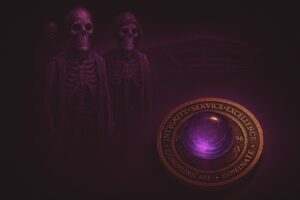
Since the publication of my memoir, The Accidental Executive, I’ve been honored by how many of you have connected with the stories of navigating policy, leadership, and the occasional bureaucratic absurdity. But every author has files that don’t quite make the final cut. Some stories, you see, are less suited for a chapter on finding purpose in public service and more for a dark and stormy night.
This is one of those files.
In the spirit of Halloween, I thought I’d declassify a memory from my Pentagon days that you won’t find in my book – let’s just say my editor felt it strayed a bit too far from “non-fiction.” So, consider this the first in a potential series of “redacted chapters,” stories from my archives that might just surface around the holidays. Grab some candy corn, lower the lights, and let me tell you what really happened with that purple water fountain.
This is a story from my time in the Pentagon I’ve never told anyone. It’s a memory that feels less like a memory and more like a scar – the kind you get from a deep burn, where the skin is slick and dead to the touch. It concerns the legend of the Pentagon’s purple water fountain. If you spent a tour of duty there, you heard the stories – the institutional inside joke about the one unsettlingly violet fountain out of 685 scattered around the Pentagon. Seasoned civil servants would wink and claim drinking from it brought a unique kind of “enlightenment,” a word they always delivered with a wry, knowing smirk. I always dismissed it as folklore.
The Pentagon at night is a different beast. By day, it hums with the energy of 25,000 people, a hive of purpose and precision. But after hours, it transforms into a hollow shell, its endless corridors stretching into eternity, manned only by a few tireless souls who remain ever vigilant in the cause of our country’s defense. The air feels heavier, colder, as if the building itself is holding its breath. The the constant shuffle and stride of thousands – so constant during the day they fade into the background – are conspicuously absent, leaving behind a silence that isn’t peaceful but unnervingly watchful. It’s as though the walls, steeped in decades of secrets, are listening, waiting, and perhaps even remembering the voices that once filled them.
As a member of the civilian Senior Executive Service, my world was one of tangible problems and measurable outcomes of IT architectural frameworks and strategic alignment. I was a builder of digital highways in the Air Force’s CIO organization. My inspiration came not from myths, but from and its core values of “Integrity First, Service Before Self, and Excellence in All We Do” and the palpable history that lined the Pentagon’s walls. The statues, flags, and art weren’t just decoration; they were threads in a tapestry that honored real sacrifice. The Pentagon was my cathedral of purpose, an immersive museum that grounded me in its legacy. I didn’t have time for ghost stories.
But one night was different.
It was October 30, 1996, the dregs of Wednesday bleeding into Thursday morning. The Pentagon had exhaled its teaming population, leaving behind an empty and watchful silence. I sat in my B-ring office on the fifth floor, the glow of my PC monitor painting my face in the colors of Windows 95. The problem on my screen was the Department of Defense Architecture Framework, a beast of my own making.
To unlock understanding and adoption of the framework, I had created something simple and tangible. I had raided my kids’ toy box for a stash of LEGO blocks and built a 3-D model that could make sense of the three architectural viewpoints: Operational, System, and Technical Architecture. My LEGO model – a colorful three-drawer system – had been a hit in briefings. People’s heads were nodding, not nodding off. But translating that tangible model into actionable, Air Force-wide policy was proving to be a nightmare. Every line of policy I wrote to simplify it just seemed to create two new exceptions. The puzzle on the screen was no longer just a puzzle; it had become a mirror, reflecting my own failure to connect two worlds that simply refused to align.
My head pounded. My throat was parchment-dry. The coffee in my mug was a cold, bitter sludge. I needed water. I needed a walk.
I pushed back from my desk, the familiar groan of my chair echoing in the stillness. I set off along a path I knew well from my “morning rounds” through the Pentagon’s outer E-ring. The silence was broken only by my solitary tread, but I felt a disquieting sense of being watched. The portraits of past leaders, men and women who had given everything in service, stared down from the walls, their painted eyes seeming to hold a silent, somber judgment, as if warning me away from a path I was already on. The walk I usually took to build relationships became a solitary patrol through a sleeping giant. The halls, normally buzzing with intent, were unnervingly still. The fluorescent lights hummed a low, predatory drone. This building was my cathedral of purpose, but tonight it felt like a museum after closing, where all the artifacts of power and history were just lifeless objects in the dark.
On a whim, born of exhaustion and frustration, I decided to find it. I was going to seek out the “Purple Fountain.” It was a legend whispered in the five-sided labyrinth, half-truth, half-spook story. The truth, as far as anyone knew, was that of the 685 water fountains in the building, only one was an unsettling shade of violet. The myth was everything else. Newcomers were told it was a navigational aid for lost couriers. Old-timers claimed drinking from it brought “enlightenment,” a word they always delivered with a wry, knowing smirk. But there were other, darker stories too, the kind told in hushed tones after a long day when the building’s endless geometry seemed to press in on you. Stories that it wasn’t a guide to a place, but a guide from this one. That the gift it bestowed wasn’t clarity, but an escape. A permanent one.
It was one of those Pentagon tales you were meant to laugh off, a piece of institutional folklore. But tonight, that folklore felt disturbingly real. In my desperate state, I wondered if the fountain’s promised insight could cut through the bureaucratic knot and show me the way to ‘Operationalize and Professionalize the Air Force’s Network.’ It was a foolish, irrational thought for a guy who lived by logic, but the late hour and the sheer weight of my task had worn down my defenses.
I took a series of turns I rarely used, descending into the Pentagon’s lower levels. The air grew cooler, then colder, carrying the scent of damp concrete and something else… ozone, like a failing electrical transformer. The polished galleries gave way to stark, utilitarian corridors where the sound of my footsteps changed, a sharp clap on marble softening to a dead, absorbent scuff on linoleum. It felt like I wasn’t just going down, but in, the building’s five concentric rings tightening around me like a fist.
I found it in a forgotten basement corridor, embedded in a wall. A single, low-wattage emergency light cast long shadows around it. Under the dim glow, the porcelain wasn’t just purple; it seemed to absorb the light, radiating a faint, internal luminescence.
A wave of irrational thirst, more powerful and primal than any I’d ever felt, washed over me. It was a craving of the soul. My skepticism evaporated. All that remained was a need to drink.
I leaned in, my heart hammering so violently it felt as though it might burst from my chest. The sound of my pulse roared in my ears, drowning out the faint, insidious hum emanating from the fountain – a vibration that seemed to crawl beneath my skin, like the low, predatory growl of something waking. My hand hovered, trembling, before closing around the old, cross-shaped handle. The metal was icy, biting into my palm with a lifeless chill. It resisted as I twisted, as though reluctant to yield. But then it turned.
A thick, dark stream sputtered and then surged from the chrome bubbler, arcing upward in a grotesque, aberrant flow. It wasn’t like water. It was more like a viscous syrup, its surface shimmering with a faint violet sheen that rippled and writhed. The smell struck me like a physical blow – a stench of corroded iron and the dry, suffocating decay of a long-sealed crypt. My throat burned with a thirst so primal it felt carved into my soul. I wanted to recoil and run, but the craving seized control of my body, dragging me forward. My lips parted as I lowered my head to the arc of shimmering liquid.
The taste was a violation. Cold, but not the crisp cold of fresh water – it was the dead, suffocating cold of something ancient and wrong. It coated my tongue with the bitterness of corroded copper, the damp rot of wet earth, and the acrid tang of something festered in darkness. My stomach twisted, a primal rejection of the poison, but the thirst was no longer mine. It was a separate, insatiable force driving me to drink. I couldn’t stop. Each swallow sent the coldness deeper, spreading through my veins like frost creeping over glass. It wasn’t just my body it invaded – it was my mind. The chill burrowed into my thoughts, stripping them bare, replacing them with something utterly alien. A clarity so sharp it felt like a blade, slicing away everything human.
The moment the last drop slid down my throat, the world around me shifted violently. The corridor seemed to lurch, as if the entire building had been wrenched sideways. My vision fractured, thick black lines slashing across my sight like the redactions of a classified document. The hum of the fountain grew into a deafening roar, a mechanical cacophony that vibrated through my skull. The air itself seemed to warp, heavy and oppressive, pressing against my chest until every breath felt like a battle. I staggered back, clutching at the wall for support, but the cold stone beneath my fingers felt wrong – slick and pulsing, as though it were alive.
The light in the corridor dimmed, flickering like a dying bulb, and then it was gone entirely. In its place, a faint, sickly purple glow seeped from the walls, casting long, shifting shadows that danced like living things. The hum of the fountain faded, replaced by a new sound – a dry, rasping whisper that seemed to come from everywhere and nowhere at once. It wasn’t a voice, not exactly. It was a thousand voices, layered and tangled, speaking in a language I couldn’t understand but still felt in my bones. The words clawed at the edges of my mind, scraping away at my thoughts like nails on glass.
And then I heard it – a faint, metallic scraping, like a blade dragged across stone. It was distant at first, but it grew louder, closer, accompanied by the same rasping whispers that now seemed to burrow into my skull. My pulse quickened, my body frozen between the instinct to run and the paralyzing weight of dread. The sound was coming from behind me. Slowly, I turned, my breath catching in my throat.
A figure emerged from the shadows, its form barely human. It wore the tattered olive drab of a Vietnam-era soldier, but its body was faded and fragmented, as though it were a corrupted image struggling to render. It moved in a loop, taking three halting steps forward, pausing to check a clipboard clutched in skeletal hands, then snapping its head up to stare at a non-existent clock on the wall. Over and over, the same sequence, like a broken machine stuck in an endless cycle. Its hollow eyes, black and empty, locked onto mine for a moment, and I felt a cold so deep it seemed to freeze my thoughts.
“Briefing… Room 4C752…” The words were a dry, rasping whisper, barely audible over over the dry scrape of his shuffling gait. “The CONOPS review… have to make the briefing…”
He stopped a few feet away, his hollow eyes locking onto mine. For a moment, neither of us moved. Then, as if satisfied, he turned and resumed his looped patrol down a side corridor, disappearing into the gloom.
A sudden, icy stillness settled in my veins, the kind of absolute system freeze that precedes a catastrophic failure. This wasn’t a haunting. I was in the haunt. The fountain wasn’t just a legend – it was a door. And I had stepped through it. I spun around, searching for the fountain, but it was gone.
The corridor behind me was empty, the walls pulsing faintly with that sickly purple light. My thoughts began to fragment, like a corrupted data file. Coherent strategy dissolved into a string of primal commands: objective-escape, threat-imminent, action-run. The air felt heavier now, pressing down on me like a physical weight. The whispers were growing louder, more distinct, echoing from every direction. They overlapped and tangled, a cacophony of voices that seemed to come from the walls themselves.
“You don’t belong here,” one voice hissed, sharp and accusing.
“Unscheduled personnel detected in Sub-Level Nine,” another rasped, cold and mechanical.
“Subject requires immediate processing and integration,” a third intoned, its tone devoid of emotion.
The words sent a shiver down my spine. I turned and ran – my frantic escape reverberated through the warped corridor.
I ducked into an alcove, pressing myself against the cold stone as a group of figures shuffled past. The door beside me was slightly ajar. Against my better judgment, I peered through the crack. Inside was an office, but wrong. A spectral executive assistant sat at a steel desk, her fingers moving over an ancient typewriter with frantic, silent speed. The paper in the carriage wasn’t paper; it was a translucent, skin-like membrane. And she wasn’t typing words. With every keystroke, a feature from her own face – an eye, the curve of her lip, a wrinkle – vanished – reappearing as a single, codified character on the page. She was typing herself into a report, one keystroke at a time. That’s what “processing” meant. It wasn’t just death. It was erasure.
The walls seemed to close in around me, the angles twisting and shifting as I moved. Doors appeared and disappeared, some opening into bricked-up walls, others into dark voids that seemed to stretch into infinity. The whispers followed me, growing louder, their words overlapping and stacking into a dry, static hiss that scraped at the inside of my skull.
I rounded a corner and skidded to a halt. The corridor ahead was filled with figures, their forms barely visible in the dim light. Airmen, soldiers, sailors, and civilians from every era of the Pentagon’s history stood motionless, their hollow eyes fixed on me. Their uniforms were tattered and stained, their faces gaunt and lifeless. Some clutched clipboards or folders, others carried tools or weapons, but all of them radiated the same cold, oppressive presence.
One by one, their heads turned toward me, a slow, deliberate, and unified movement. In the suffocating silence, the collective shift of their attention was a physical blow. They saw me – warm, solid, alive. An anomaly.
“New personnel,” one of them whispered, its voice like the rustle of dry leaves.
“Are you… the briefer?” another asked, its tone laced with confusion and something darker.
I took a step back. The figures began to move, their jerky, mechanical movements sending a fresh wave of terror through me. They weren’t malicious. They were something worse: indifferent. To them, I wasn’t a person. I was a mistake, a glitch in their perfect, eternal system. And mistakes had to be corrected.
The figures began to close in, their movements slow but deliberate, like the grinding of gears in a machine. Their hollow eyes burned with cold, unfeeling light, and their whispers grew louder, overlapping into a suffocating chorus.
“Unscheduled personnel entry detected in Sub-Level Nine.”
“Cross-referencing… no active security clearance found.”
“Subject requires immediate processing and integration.”
The words wrapped around me like chains, each syllable tightening the grip of panic in my chest. My breath came in shallow gasps, and I stumbled backward, my legs trembling beneath me. The air grew colder, heavier, pressing down on me like a physical weight. I could feel their presence closing in, their skeletal hands reaching out, their whispers burrowing into my mind.
“You don’t belong here,” one of them rasped, its voice like the rustle of dry leaves.
“You must be… integrated,” another hissed, its tone sharp and final.
Integrated. The word sent a jolt of terror through me. They didn’t want to kill me – they wanted to make me one of them. To strip away everything from me and bind me to their endless, purposeless cycle. I would become another cog in their machine, another ghost wandering the halls of this necrotic Pentagon, forever trapped in their cold, unfeeling system.
“No,” I whispered, my voice trembling but defiant. “I don’t belong here.”
The figures hesitated for a moment, their movements faltering as if my words had disrupted the rhythm of their system. But then the whispers grew louder, more insistent, and the figures began to advance again with the uncoordinated gait of broken machines.
I turned and ran.
My footsteps echoed in the warped corridor, the sound bouncing back at me in distorted, mocking tones. The walls seemed to shift and twist as I moved, the angles bending in ways that made my head spin. Doors appeared and disappeared, some opening into bricked-up walls, others into dark voids that seemed to stretch into infinity. The whispers followed me, their words overlapping and stacking into a dry, static hiss that scraped at the inside of my skull.
“Submit to correction…”
“Await processing…”
“Escape is not permitted…”
The air grew so cold it felt hard, each breath a shard of glass in my lungs. Their presence was a physical pressure at my back, a thousand cold fingertips pushing me forward. It wasn’t thought, it wasn’t courage; it was just my body’s dumb refusal to stop moving. The dim purple light flickered and sparked, forming a faint, treacherous path that seemed to lead back the way I had come. It wasn’t a guide of hope – it was a lure, the system showing me the only approved exit. An exit that likely led to a different kind of processing.
But I had no choice. The whispers were closing in, the cold presence of the figures pressing against my back like a physical weight. I followed the flickering path, my lungs burning and my heart pounding. The coin in my hand pulsed with warmth, its glow growing brighter with every step. It was my anchor, my shield, the only thing keeping me tethered to the real world.
I rounded a corner and skidded to a halt. The purple fountain stood before me, its porcelain surface glowing with a malignant light. The water in the basin swirled violently, a vortex of inky blackness that seemed to pull at the air around it. The whispers grew louder, their tone shifting from cold authority to desperate fury.
“Unauthorized personnel…”
“Do not approach the fountain…”
“Access denied…”
The figures were closing in, their gaunt forms emerging from the shadows, their hollow eyes fixed on me. At their center stood a figure who commanded the space. He wore the four-star insignia of a General in the Air Force, his uniform perfectly pressed, but the fabric seemed woven from shadow and faded ribbons. Where his face should have been, there was only a smooth, polished blankness, like worn marble, as if his identity had been redacted and deemed irrelevant to his eternal function. He was the ultimate authority, and the ultimate prisoner.
“You cannot leave,” he said, his tone filled with cold finality. “You have been decommissioned.”
I ignored him. My focus was on the fountain, the swirling vortex in its basin, the faint, flickering light that seemed to pulse in time with the challenge coin in my hand. I stepped forward, the warmth of the coin spreading through my body, pushing back against the suffocating cold of the room.
The figures hissed and recoiled, their movements jerky and mechanical. The tall figure stepped forward, his presence radiating a cold, unrelenting power.
“Your operational architecture is incompatible,” he growled, his voice a dead monotone. “Your systems are rogue. Your technical framework is… sentimental.” He said the last word as if it were a disease. “We will correct you. Every memory, every hope, will be flensed and collated into a new, efficient framework. You will not be filed. You will become the file.”
“No,” I said, my voice steady and defiant. “I’m leaving.”
With a surge of adrenaline, I lunged forward, shoving the coin hard against the fountain’s cold, cross-shaped handle. The reaction was instantaneous and violent. A deafening clang of bronze on porcelain echoed through the room, and the purple glow of the fountain flickered and dimmed. The water in the basin began to swirl faster, the vortex growing larger and more violent. A blast of warm, humid air washed over me, carrying the familiar smell of diesel fumes and wet asphalt – the smell of the real world.
The portal was open.
The figures shrieked in fury, their whispers turning to screams as they lunged toward me. Their skeletal hands grasped at my arms, my legs, their touch like biting frost. I could feel their desperation, their need to pull me back, to keep me trapped in their system. The coin didn’t glow. It grew heavy. Impossibly dense. An anchor of verifiable reality in this shifting nightmare. The whispers faltered as I neared. Not because it was holy. Because it was authentic. My proof of existence. An intolerable paradox they could not process.
I didn’t hesitate. I dove headfirst into the swirling vortex, the screams of the figures echoing in my ears as the world dissolved into a blur of light and shadow.
I landed hard on a polished linoleum floor, gasping for air that was warm and blessedly normal. The fluorescent lights overhead buzzed faintly, their steady hum a welcome sound after the oppressive silence of the other side. I looked around, my heart still racing, and saw two night-shift security guards standing over me, their faces filled with concern.
“Sir, are you alright?” one of them asked, his voice pulling me fully back into reality.
I was on the floor in a normal, empty hallway. The purple water fountain was still there, but it was just a fountain now, its violet porcelain looking dull and ordinary under the fluorescent lights. My challenge coin lay beside me, its familiar warmth replaced by a deep, sepulchral cold. I picked it up, turning it over in my hand, and saw that the bronze was stained with a faint violet patina around the edges – a tarnish that would never polish away.
There was no dark stone, no ghosts, no whispers. But even now, all these years later, I can still feel the cold. No amount of water can quench the dryness that has settled deep in my bones. And sometimes, late at night, when I wrestle with a complex problem, a flash of violet inspiration will strike – a perfect, cold, and utterly inhuman solution. I’ll wake from nightmares of twisting stone corridors, and I swear I can feel a faint, violet glow behind my eyes.
The legend was true; the purple water fountain showed me the way out. But I know it’s still waiting for me to come back. And my challenge coin? I keep it locked in a small safe, hidden behind a panel in my study, a barrier as much for my protection as for its containment. The steel of the safe is always cold in that one spot.
And on cool autumn days, I know without looking that a single, shimmering bead of dark, violet water has condensed on the coin inside.