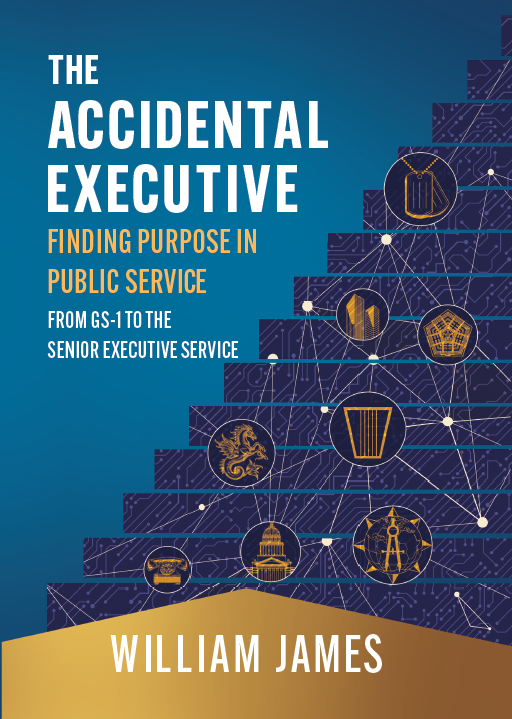
The Accidental
Executive
Finding Purpose in Public Service
He didn’t plan on any of it. The first federal job was GS-1 file clerk — logging telephone tariff records at Scott Air Force Base in 1974. He was nineteen. What followed was one of the stranger career arcs in the history of the civil service.
Fifty years. From file clerk to SES. Written with warmth, specific detail, and the earned perspective of someone who started at the absolute bottom and never forgot what it looked like.
Chapter 2 — The Bottom Rung
Scott Air Force Base bustled with activity. The site was a hub for Air Force medical evacuation missions, with planes taking off and landing, transporting military patients destined for hospitals at Scott and other medical treatment facilities in the United States.
At the edge of the base stood a low, nondescript office building. The year was 1974, and the world outside the windows was abuzz with change and upheaval in the Cold War, post–Vietnam War era. The sign above the door read DEFENSE COMMUNICATIONS AGENCY. Crossing the threshold of this drab building, I stepped out of the steam of the Southern Illinois summer and into the soup of US government civil service, where mission met bureaucracy. Walking down the hall, plodding across the waxed and worn linoleum tile floor, I noticed a faint squeaking noise coming from my recently shined shoes. When I finally found the correct office number, I took a deep breath, squared my shoulders, and stepped into this strange new world. The squeaking sound of my shoes stopped, replaced by a whisper of uncertainty.
Entering the room, I was struck by the brilliance of fluorescent lights mixed with sunlight fighting its way through dirty windows. Tiny dust particles tumbled through the light in their slow descent onto faded green metal desks. An unmistakable air of shabbiness and muted efficiency hung in the room. The walls were a dull, institutional green adorned with typewritten announcements, policies, rules, and regulations. The slow-moving air held the scent of paper, ink, and stale coffee.
At the far end of the room, a door opened to a vast library with row upon row of gray metal shelves lined with hundreds of black three-ring binders, each labeled meticulously, their spines bearing signs of frequent handling.
At the desk to my immediate right, a plump woman hunched over a typewriter. Her fingers danced on the keys. She noticed me, looked up, and smiled.
“Welcome,” she said. “I assume you’re Bill James, the new clerk. I’m glad to see you. Let me show you around.”
So began my career as a GS-1 Clerk in the Tariffs Library of DECCO. My pay was two dollars and fifty cents an hour. Those three summer months would ultimately be counted as official time toward my civil service retirement pension — a long-term benefit that stretched far beyond my immediate time horizon.
I had no idea where it would end.
He had no idea where it would end. Now you can find out.
GS-1 file clerk to Senior Executive Service, fifty years of federal IT told from the inside — with the frankness of someone who started at the absolute bottom.
Order Now on AmazonPrefer updates over purchases? Get news on The Chariot Protocol and future books from the author.