The Long Way Home
A story set before the events of The Chariot Protocol
— — —
The welcome home took fifty years. Somebody finally got it right.
Phill Dawson came through the doors of Washington National Airport at midday, the terminal moving at the unhurried pace of a Wednesday in October. Duffel on one shoulder. Discharge papers in his breast pocket. His left leg telling him, with its new and permanent frankness, that he’d been on his feet long enough.
He was crossing toward the exit when he heard it.
A group of maybe six or seven, college age, clustered near the far wall with backpacks and long hair and the posture of people performing their own convictions for each other. One of them spotted the uniform — took it in the way you take in something you’ve already decided about — and said, loud enough to carry across the corridor, quiet enough to deny: “There goes one of Nixon’s baby killers.”
A couple of them laughed.
The word landed and something in Phill went very still — not the flinch of a man who’d been hit, but the stillness of one who’d just acquired a target. His eyes moved without his head turning: seven of them, twenty feet off his left shoulder, the easy stance of people who had never had a reason to stand up straight. A couple were grinning now, waiting to see what the man in the uniform would do. There were other veterans in this terminal — he’d seen them coming through — and every one of them had heard it too.
He wanted to stop. The Sergeant in him wanted very much to turn around and have a precise and unhurried conversation about the word killer with a twenty-year-old who had never left the country. He knew how that conversation would go.
But this was new ground, and a Staff Sergeant doesn’t commit until he knows the ground. He was twenty-two years old and one day out of uniform and he didn’t know the rules here yet. He’d learn them. Until then he’d move.
His chin stayed level. His pace didn’t change.
He was almost to the exit doors when a young man in a fringed jacket stepped out from the group and dropped his paper cup full of coffee directly in Phill’s path — lid popping loose, the milky-brown liquid spreading across the floor in a slow arc. Whether the timing was accidental was a question Phill chose, in that moment, not to answer.
He stopped.
His left leg registered the sudden shift in weight and sent its familiar complaint up through the hip. The young man was already back with his group, not looking at Phill, one hand raised in a gesture that was either apology or its opposite. A couple of them were watching now, waiting to see what he’d do.
Phill looked at the coffee on the floor. He looked at the exit doors. He shifted his weight off the bad leg, took one deliberate step to the right, and walked around the puddle at the same pace he’d been walking before.
He went through the doors and out into the October cold.
He did not look back.
— — —
He took a cab to Vienna. The driver had the radio going — a protest song, the kind that had been inescapable for years — and Phill watched the trees along the George Washington Parkway go orange and red and let his mind settle into the quiet he’d learned to find on long patrols. He was thinking about his father. About the MASH unit nurse from Ohio named Miller who had talked about her sister’s graduation while the surgeons worked on his leg, who had told him in a voice that allowed no argument that they had saved it, and about what she’d confirmed under those canvas tents — the same thing his father had been trying to pass him for years without words: the system might fail you. The person standing next to you won’t.
His father had grown up on a farm outside Carthage, Illinois, enlisted in the Navy before his eighteenth birthday, served as a sparky in the Pacific, and survived Typhoon Cobra in December 1944 when the storm took nearly eight hundred sailors and three destroyers into water with no bottom. He came home in 1946 and never spoke of it, met Betty Hollis at a USO dance in Washington — a WAVE from Fairfax, twenty years old — and followed her home. They settled on Center Street in Vienna and Phillip James Dawson was born in 1948, named after both grandfathers, and grew up understanding without being told that his father had gone somewhere genuinely hard and come back and kept going, that this was the lesson, and that it passed between men without words.
At seventeen, sitting at the kitchen table with a history textbook he wasn’t reading while the evening news talked about Vietnam — men going, some not coming back, classmates whose older brothers had enlisted, one whose brother hadn’t come home — he thought about his dad, Earl, who had gone when his country needed him and come back and carried it silently. He thought about his mother, Betty, who had put on a uniform and found something larger than herself. He closed the textbook and opened a phone book to find a number for the Marine Corps. He told his parents nothing.
Two weeks after his eighteenth birthday, his father drove him to the Armed Forces Examining and Entrance Station in Washington, waited while Phill raised his hand and signed the papers and accepted a meal voucher, and afterward they ate at a drug store down the block without talking much. After lunch, they walked back and Earl put out his hand. Phill shook it, and his father held on one beat longer than the gesture required — and in that beat was everything Earl Dawson had no words for: the set jaw, the eyes that had seen Typhoon Cobra and never described it, and something that filled those eyes without spilling, held back by the same will that had kept him quiet through everything else. “Write your mother,” Earl said, his voice steady at some cost. Phill said yes sir and got on the bus without looking back.
He came home briefly in 1969, re-enlisted for a second tour, said yes sir to the same instruction from the same sidewalk, and went back. In March 1970 a firefight in the jungle took his leg out from under him in the red mud and he woke in a MASH unit to green canvas and hard light, and a face above him — brown hair working loose from a cap, vowels that said Ohio — told him her name was Miller and that they had saved his leg. He filed her away the way he filed everything that mattered. He went back to Vienna with a piece of metal in his thigh.
At El Toro in October 1971 he signed the discharge papers and drew his pay. A corporal handed him the envelope containing five years of his life without quite meeting his eyes. He caught a ride to LAX and bought a ticket home.
— — —
The cab turned onto Center Street and the town was mostly what he remembered. More cars in more driveways. A shopping center on Maple that hadn’t been there. Tysons Corner had risen where there had been fields. But Center Street and the fire station were pretty much the same.
When the cab stopped, his mother was on the porch before he’d finished paying.
She had dressed for the occasion — her good dress, her good earrings — and she was wearing White Shoulders, her special perfume, the one she saved for the things that mattered. She came down the steps the way she moved when something mattered and held on with both arms. He stood there with his duffel at his feet and let her. She smelled of White Shoulders and the kitchen underneath it, and for a moment Vienna was exactly the size he needed it to be.
Earl was in the doorway behind her. Same posture. Same face. His jaw holding something in the way it did. He looked at Phill over Betty’s shoulder and gave one slow, deliberate nod — the nod of a man who had been carrying the weight of the waiting for a long time and was finally setting it down.
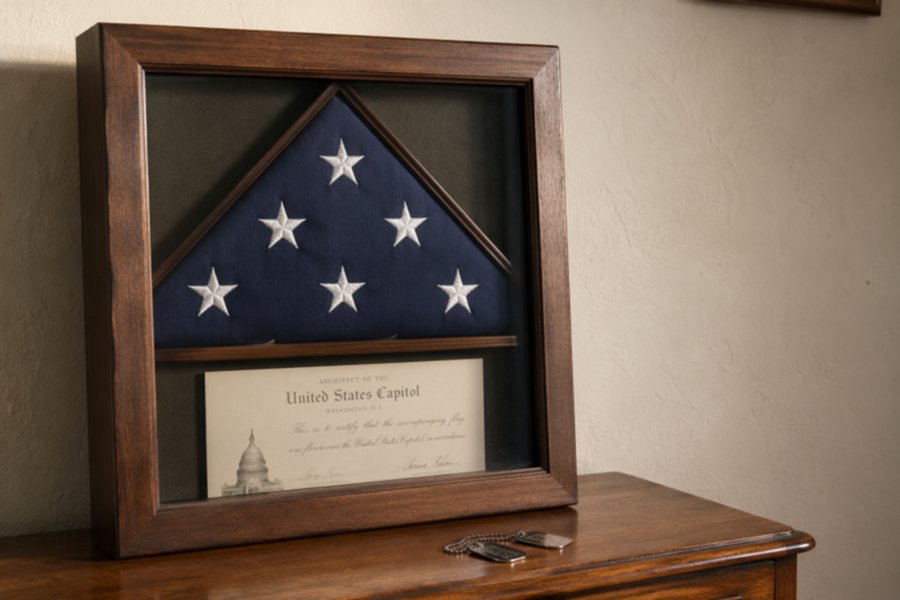
Inside, on the kitchen table, sat a triangular walnut shadow box. Ten days earlier, a package had arrived — Betty had signed for it, not knowing what it was — containing the box and a folded note, signed by seven men in handwriting he recognized from two tours: We had it made for you, Staff Sergeant. Inside the box, behind the glass, an American flag was folded with the precision the Corps demanded, and a certificate stated that the flag had been flown over the United States Capitol in honor of Staff Sergeant Phillip James Dawson, USMC, for meritorious service and leadership in the Republic of Vietnam.
Phill stood at the kitchen table for a long moment. Betty stood quietly in the doorway and watched.
They sat with their coffee in the quiet that collects between people who have too much to say and no clear way to begin. The shadow box sat on the table between them. Vienna went about its evening outside the window.
Earl refilled his mug and sat back down. “Leg giving you trouble,” he said. It wasn’t a question.
“Some.”
He’d noticed the hitch in Phill’s walk from the doorway. He noticed everything and said the necessary fraction of it. He mentioned the VA medical center in DC the way he mentioned things that mattered.
Betty refilled her own coffee and sat back down and looked at her son with the attention of a mother taking careful inventory of the things that don’t announce themselves.
“Are you hungry?”
“I’m fine, Mom.”
“That’s not what I asked.”
He almost smiled. “Yes. I’m hungry.”
She got up. Earl waited until her back was to them, then turned his mug in his hands once and looked at the table between them.
“I didn’t come home to a parade either,” he said. “The Pacific. ’46. Different war, different water. But I know what it is to walk back into a place that’s moved on without you.” He paused. “Doesn’t mean it doesn’t need you. Doesn’t mean you don’t need it.”
He picked up his mug and drank. No instructions. No elaboration. Just the one plain thing left between them like a tool Phill could pick up whenever he was ready.
He looked at his father — the set jaw, the steady hands, the economy of a man who spent words only on what they could carry — and understood, finally, what had been in the extra beat of the handshake. Both times.
Earl hadn’t been saying goodbye. He’d been making a transfer. A way of carrying weight without surrendering to it. A way of showing up for the next thing, and the thing after that, without explanation and without complaint — because that was how Earl Dawson had been built, and he’d made certain it was how his son was built too.
“I know,” Phill said.
Earl nodded once. The end of it.
Betty set a plate in front of him. The three of them ate together while their little town turned through its quiet evening outside the window.
— — —
The shadow box went on the dresser in his room, where he could see it from his bed. He got a job at a building supply on Maple Avenue the second week he was home and helped Earl on electrical jobs in the evenings, learning the civilian rhythms of work without orders. He was finding his footing. Slowly, carefully, the way you find footing on new ground.
He told himself he was doing fine.
— — —
The first time, he let it go almost without thinking.
It was a Saturday morning in November, three weeks after he’d been home. Earl had a supply run to make — wire, junction boxes, a replacement breaker — and Phill rode along. The building supply was busy for a Saturday, a line at the counter, contractors and homeowners and handymen with their lists.
Earl had his items arranged on the counter, waiting for the clerk. A man came in behind them — late thirties, good coat, the easy confidence of someone who’d recently arrived in Vienna from somewhere that moved faster. He stepped around Earl without looking at him, dropped a coil of wire and two boxes on the counter in front of Earl’s items, and said to the clerk, “Just ring these up. I’m late.”
The clerk looked at Earl. Earl pulled Phill back a half-step by the elbow and said to the clerk, “Go ahead, take care of him. We’re not in a hurry.”
The man in the good coat didn’t acknowledge them. Didn’t look. Just waited for his receipt and left.
Earl pocketed his hands and waited for the counter to clear. “Town’s changing,” he said, not to Phill specifically, not to anyone. “Fast money doesn’t wait in line. No sense making a thing of it.”
Phill had felt his instinct fire — the precise, calm, two-sentence correction that would have realigned the situation without drama. He’d had it ready. He’d let Earl’s hand on his elbow stop it.
He told himself it was fine. But the pebble sat in his chest on the drive home, small and smooth and not worth mentioning.
— — —
The second time cost him more.
It was a Saturday morning in December, the Vienna American Legion post hosting its monthly public breakfast. Earl had been coming for years. He’d brought Phill to introduce him, to begin the introduction to this community of veterans who had served and come back and stayed.
The banquet hall was full — families, neighbors, townspeople who came for the pancakes and the coffee and the easy warmth of a room full of people who knew what they owed. Betty had come too, dressed in her good wool coat, pleased to be out on a Saturday morning with both her men.
Along one wall, a folding table had been set up with a display — photographs, a poster, a sign-up sheet. A man in his fifties, organized and well-meaning, was taking names for a Veterans Day recognition program the post was planning. Earl signed his name. Phill signed his name.
Betty stood for a moment, looking at the display. Then she stepped forward and approached the man at the table.
She told him she had served — WAVE, 1943 to 1946, stationed in Washington — and said it quietly, the way she said things that mattered to her, without ceremony, without asking for anything except to be recognized.
The man smiled. It was a kind smile and that almost made it worse. He said, “That’s wonderful, Mrs. Dawson,” and turned back to his clipboard. Then, as if remembering she was still there, he added, “We’re focusing on the men for this one.” He was already moving to the next person in line. “You understand.”
Betty stood at the table for just a moment — not long, just the time it takes a person to absorb something and decide how to carry it. Then she turned and walked back to where Earl and Phill were standing.
Earl put his hand over hers. “We don’t need our names up there, Betty,” he said gently. “Let’s get some coffee.”
She nodded. She was fine. She was completely fine. But Phill had seen the slight — the softening of her spine, the slope of her shoulders, the adjustment a person makes when they have just been told, pleasantly, that they don’t count.
He had the words. He knew exactly what to say to the man at the table — not loudly, not with heat, just the facts delivered with complete authority: She served. Her name goes on the list. Four seconds. The man would have written it down.
Instead Phill followed his father to the coffee table.
He poured himself a cup he didn’t want and drank it standing up, looking at the veterans and their families filling the hall, and felt something he hadn’t felt since the jungle: the specific, corrosive discomfort of a standard walked past.
He had accepted it. For Earl. Because Earl needed him to be the son who came home quietly, who found his footing, who didn’t make trouble in the places Earl had built his life.
He told himself it was fine.
It was not fine.
— — —
The third time there was no telling himself anything.
It was a Thursday afternoon in late January, cold enough that the puddles on Church Street had grown ice around their edges. Phill was walking to Kirby’s — he’d offered to pick up a flannel shirt Earl needed for a job site — when he heard it.
Kirby’s Men’s & Boys’ Clothing occupied a storefront two doors down from the corner, its American flag flying from a pole mounted in a bracket above the door the way it had since Mr. Kirkland opened the store in the fifties. A group of eight or nine was moving down the street, some carrying hand-lettered signs, their voices loud in the cold air. The antiwar protests that had boiled over in the spring had quieted by fall, but they hadn’t stopped — they’d just moved off the front pages and into the side streets of places like Vienna, smaller and angrier and less organized. This group was young and cold and looking for something to do with what they felt.
One of them reached up and took the flag.
Just like that. Reached up, pulled the pole from its bracket, and held it up — flag and all — while the others cheered. Then someone produced a can of lighter fluid. They dropped the pole and flag on the sidewalk, doused them, and one of them crouched with a match.
Kirby appeared in the doorway of his shop, a compact man in his late forties, his face going through things quickly. He had a bad knee from Inchon and the particular stillness of a man calculating odds. His shop was his livelihood. He had a wife and two kids.
Phill heard Earl’s voice in his head: No sense making a thing of it.
He was already moving.
He didn’t run. He walked — fast, purposeful, the limp eating into every other stride — and something in the way he came toward them made the group go still. They watched him close the distance and didn’t move. Whatever they’d expected from the afternoon, it wasn’t this.
He came in among them without a word, and they parted. The flag was burning on the sidewalk, the lighter fluid feeding a low ugly flame, the nylon melting and curling at the edges. Phill planted his boot on it and ground it out, back and forth, until the flame was dead and the fabric was scorched and smoking beneath his sole.
He stood over it. The group had pulled back into a loose semicircle. Nobody spoke.
Phill looked at them — with the particular, settled attention of a man who has seen what flags come home draped over. He let them look at him. At the leg. At the way he stood. At what it cost to get from there to here.
Then he said, quietly: “Men died under that flag. Good men. Some of them boys I knew.”
That was all. No speech. No argument. Just the plain, undecorated fact, set down between them on a sidewalk in Vienna, Virginia, in January 1972.
The one who had struck the match was nineteen, maybe twenty. He looked at the scorched flag on the sidewalk. He looked at Phill.
“The war is wrong,” he said. His voice had lost some of its morning confidence.
Phill held his eyes. “You may be right,” he said. “But that flag didn’t start it.”
The group moved on down the street, their voices quieter as they rounded the corner.
Phill crouched carefully and worked the flag free from the pole. It was scorched, melted at the edges, and smelled of lighter fluid in the cold air. He tucked it under his arm. A burned flag needed to be properly retired. He’d take care of that himself.
He looked at Kirby in the doorway.
The man looked back at him the way veterans look at each other sometimes — the look that takes a count of what a man has cost himself. He didn’t say thank you, which was the right call.
Phill looked at the empty bracket above the door.
Then he said, “I’ll be right back.”
He walked to Center Street and turned toward his house. Four houses down, through the front door, up the stairs, into his room. He stood in front of the dresser and looked at the shadow box.
He stood there for a moment. Then he took it down and removed the flag.
He carried it back to Kirby’s and attached it to the pole where the old flag had been. The Capitol flag. The flag his men had arranged for him. Their names behind it, invisible from the street but there.
He stepped back onto the sidewalk and looked at it.
It was the right flag for this wall on this street in this town. He knew it the way you know things that are simply true.
Kirby stood beside him, looking at it too.
“You sure?” Kirby said.
“Yes,” Phill said.
He bought Earl’s flannel shirt and walked home in the January cold.
— — —
Fifty years later, he was in the right chair before he’d asked for it — Mike Sanders’s backyard, late summer, years on from Center Street. Charcoal smoke and cut grass and an afternoon with nothing pressing on it. The chair had room to stretch his leg out — Peggy had pointed him to it before Mike had the grill going, just said that one’s yours and moved on without drawing attention to why.
The Pabst Blue Ribbon was already there when he sat down. Ice cold, the bottle sweating lightly in the heat, as if it had been waiting in a cooler with his name on it — because it had. Peggy had made sure of that before he’d even come through the gate.
He gave Mike a hard time about the maple tree he’d been meaning to deal with since the previous administration. Mike absorbed it with the steadiness of a man who understood that the ribbing was the whole point, and that the whole point was real.
Later in the afternoon, he felt her hands on his shoulders before he heard her.
Peggy leaned down behind his chair, close enough that he caught it — just a trace, the lightest touch of it. White Shoulders. Betty’s perfume.
He didn’t have time to prepare for what that did to him.
Peggy said two words close and quiet, the way you say something meant for one person only.
“Thank you.”
Then she was gone, back to the yard and the afternoon, as if nothing had happened.
Phill wrapped both hands around the Pabst bottle. It was still cold — colder than it had any right to be after an afternoon in the August sun — and he held it the way you hold something when you need something to hold. Not for long. Just until the moment passed through him and settled.
He knew what she meant — not only for the years and what they’d cost, but for what a man does with the years after. For the kid with the prosthetic foot in the VA atrium who didn’t know yet that someone was going to see him. For the phone number on a napkin and the call at eight o’clock.
Earl Dawson had never heard those two words.
He’d never needed to. He’d always known.
Phill took a long pull of his beer and watched the light move through Mike’s overgrown maple.
Fifty years, he thought. Worth it.
— — —
Phill Dawson — Marine, neighbor, and the human face of the mission — is a central character in The Chariot Protocol, a novel about what happens when the systems we trust stop working, and the people who hold the line anyway. Coming September 22, 2026.
© 2026 William C. James. All rights reserved.
He gave away his own Capitol flag to save a stranger’s front door.
Phill Dawson swallowed two slights before he stopped swallowing them — then handed over the one thing his own men had made for him without a second thought. Fifty years later, two words from Peggy Sanders told him it was worth it. The novel is what those fifty years led to. Get it first.