In Order
A story set in the years before the events of The Chariot Protocol
— — —
The alarm didn’t wake Ann Deering. She was already awake.
She lay still for a moment in the grey Scranton dark, running the day’s sequence before she rose — the way she ran through everything before she touched it. Then she got up, turned the alarm off with two seconds to spare, and began.
The medicine cabinet first. She opened it the way she opened it every morning — not checking, exactly, more the way you confirm a fact you already know. Bottles and tubes stood in three rows, labels faced forward, grouped by function, tallest to shortest within each group. Vitamins, then prescriptions, then everything else. She’d set it up this way the first week in the apartment and it had not required adjustment since. She knew where everything was. She was always prepared. These two facts were, to Ann, the same fact.
She dressed. Checked the bag she’d packed the night before. Lifted her wallet from the dresser — bills faced up, heads up, ordered largest to smallest — and slid it into her pocket. Outside, Scranton was doing what Scranton did in November, which was make no particular promises about the day. Ann walked to work with her collar up and her mind already at her desk.
The state claims office where Pennsylvania placed its benefits processors occupied the third floor of a building that smelled of old paper, with radiators that clanked before they warmed. Ann had been there four months. She knew every procedure, every regulation, every form number. She had read the state’s claims manual cover to cover in her first week, not because anyone asked her to but because the manual was the map and Ann did not enter unfamiliar territory without a map. The process had a shape. She had learned its shape. That was how you helped people — not through shortcuts or instinct or goodwill alone, but by knowing exactly where you were in the system and what the system required next.
She knew which of the three copiers jammed on legal size and which fluorescent tube in the break room flickered on cold mornings. She knew these things because she paid attention, and she paid attention because it seemed to her the basic courtesy you owed a place where you spent eight hours a day.
She was good at her job. She was also, four months in, eating lunch alone.
It wasn’t for lack of trying. She had tried with Donna from intake, who was friendly and loud and laughed at everything, and for two weeks they’d eaten together in the break room. Then one afternoon at the diner across the street, waiting for their sandwiches, Ann had noticed the condiment caddy.
It wasn’t that it bothered her exactly. It was that the sweetener packets were a mess — whites and pinks and yellows and blues jumbled together, some facing one way, some another, several bent at the corners. Ann’s hand moved before she’d made any decision about it. She pulled the caddy toward her and began — whites first, then yellows, then pinks, then blues, each group aligned at the front edge, each packet faced the same direction, the bent ones smoothed as best she could against the table.
It took perhaps forty seconds.
She looked up. Donna was watching her with an expression Ann had seen before and had not found a solution to.
“Sorry,” Ann said. She pushed the caddy back.
“No, it’s —” Donna said. “It’s fine.”
It wasn’t fine. Ann understood this. She ate her sandwich and talked about the claims backlog and walked back to the office and two weeks later Donna started eating at her desk.
Ann wasn’t surprised. She was precise and a little lonely and completely herself, which she understood was not always a combination that made things easy. She had filed this fact. She had not solved it.
She was twenty-four years old. She was working on it.
— — —
Warren Michaels arrived on a Thursday.
Ann knew he was coming — the office manager had mentioned a transfer from Philadelphia, claims adjudicator, starting the fifteenth — and she had filed this information without particular interest. People transferred in. People transferred out.
Then he walked through the door and Ann, who was precise about most things, had to admit she’d filed the information incorrectly.
He had a face built for outdoor light — square jaw, sun creases starting early at the corners of his eyes, the kind of look that didn’t try because it never had to. He moved through the bullpen with an ease that wasn’t arrogance, stopping to introduce himself at each desk, remembering names immediately, laughing at things that were actually funny rather than at everything indiscriminately. Ann watched this from her peripheral vision while appearing to proofread a denial letter. Her chest did something involuntary. Her hands went still on the page. She hadn’t wanted anything this specific in longer than she wanted to calculate.
He stopped in the doorway of her section. She knew this because she could see him in the reflection of the window she faced — a trick of the old glass she’d discovered in her first week and had not mentioned to anyone. She watched him take in her desk. The color-coded binder. The regulation tabs at identical heights. The inbox and outbox squared to the desk’s edge.
He stood there for a moment longer than necessary.
Then he moved on.
Ann returned to the denial letter. She read the same sentence four times before it resolved into meaning.
— — —
He appeared at her elbow three days later with two cups.
“I got your order wrong,” he said, setting one in front of her. “I’m telling you upfront so you can’t accuse me of false advertising.”
Ann looked at the cup. It was her order — medium coffee, room for cream, no sleeve because she didn’t mind the heat. She looked up at him.
“You got it right,” she said.
“I know.” He sat down in the chair across from her desk that no one sat in. “I said that so you’d look at me.”
She looked at him. He seemed to find this satisfactory.
His own cup she noted without looking directly at it — espresso, single shot, paper cup barely larger than her fist. She had no idea where he’d found it. She looked at the clock on the wall. Eight fifty-seven in the morning.
She said nothing. She reached for her coffee.
“It’s a legitimate morning drink,” Warren said.
“I didn’t say anything.”
“You did something with your eyes.”
She had, in fact, done something with her eyes. She returned them to the denial letter.
“Espresso is traditionally an after-meal drink,” she said. “In Italy, ordering one before noon would be —”
“I’m from Philadelphia,” Warren said.
She looked at him again. He took a sip of the espresso. His expression remained composed, which she suspected took some effort.
“How is it?” she said.
“Tremendous,” he said.
She almost smiled. He noticed the almost and appeared to file it for later.
They talked for twenty minutes. He asked questions the way people read — moving forward without backtracking, following one thing to the next with genuine interest. He asked about the color-coded binder. She explained the system — not just the tabs but what they tracked. Each color corresponded to a stage in the appeals process. Blue for initial filing, yellow for documentation pending, red for hearing scheduled, green for closed. The heights were identical because the tabs were a timeline and a timeline had to be read in sequence, left to right, without ambiguity. If you could see the process, you could see where it was working and where it was about to fail.
He didn’t nod politely the way people nodded when they were waiting for her to finish. He asked what happened when a case stalled between stages. She told him. He asked what the most common point of failure was. She told him that too. He asked another question after that, and by the time she noticed, twenty minutes had passed.
When he left he took his espresso cup with him. At the door he paused.
“Tomorrow I’m getting a macchiato,” he said. “I don’t know what that is but it sounds more defensible.”
Ann looked it up after he left. He had mispronounced it. She decided not to tell him.
— — —
Three weeks later he saw the wallet.
They were at the diner — the same one where Donna had watched her sort the sweetener packets, which Ann noted without comment — and Ann was paying for her own lunch because she had established this as the arrangement and Warren had accepted it without argument, which she respected.
She opened her wallet. Bills faced up, heads up, largest to smallest. She found the exact amount without searching, paid, and looked up to find Warren watching her hands with the same expression he’d had in the doorway of her section.
“Show me that again,” he said.
“I just paid. There’s nothing to show.”
“The wallet. How it’s organized.”
She looked at him. He was not mocking her. He was interested, in the specific way she was learning to recognize — the way he’d been interested in the binder tabs and the follow-up questions. She opened the wallet again and held it out.
He studied it for a moment.
“Largest to smallest,” he said.
“Largest to smallest, heads up, faced the same direction. I know exactly what I have and where it is. I’ve never stood at a register searching.”
Warren was quiet for a moment.
“I keep mine in my back pocket with a rubber band around it.”
She looked at him. He looked back. He wasn’t embarrassed. He wasn’t performing the confession. He was just telling the truth about himself the way she’d just told the truth about herself, and something about the equivalence of that — the rubber band offered alongside the ordered bills without hierarchy — unlocked something in Ann’s chest that she hadn’t known was locked.
She laughed. Short, surprised, real.
Warren smiled. Not the smile he gave everyone. Something quieter and more specific. He let a beat pass.
“I have to ask,” he said. “The lingerie drawer. Same system?”
Ann looked at him. He held her gaze without flinching, which told her the question was exactly as deliberate as it sounded.
“That,” she said, “is none of your business.”
“That’s not a no,” Warren said.
She picked up her check. She was, she realized, still almost smiling.
Ann, without quite knowing it, had gone further than she’d planned.
— — —
Ann fell for Warren Michaels the way she did most things — completely, systematically, and with full awareness of what was happening before she had any idea what to do about it.
She catalogued the evidence without meaning to. The way he remembered not just her coffee order but that she took it without a sleeve. The way he sat in the chair across from her desk — the chair no one sat in — as though he’d been sitting there for years and intended to keep. The way he’d said I was telling you upfront before she could accuse him of anything, which suggested he paid attention to how she thought as well as what she said.
She was, she recognized, in some difficulty.
She analyzed the situation on a Sunday morning in November, standing at her medicine cabinet. The evidence was clear. Her conclusions were reasonable. Her options were limited. She could continue being exactly herself — precise, ordered, the woman who sorted sweetener packets and explained wallet systems to men she was trying not to think about — and see what happened. Or she could make an adjustment.
She looked at herself in the mirror for a long moment. Then she went to the drugstore.
— — —
The desk was the first thing.
On Monday morning Ann arrived early, before Warren, and looked at her desk the way a general surveys terrain. The color-coded binder went to the credenza. The inbox and outbox she moved three inches off the squared edge. She took two files from the done pile and left them open on the desk’s surface, casually, the way people left things when they weren’t thinking about where things went.
She sat down and looked at what she’d done.
She straightened the files. Then made herself un-straighten them. Then compromised on a position she calculated as socially acceptable disarray and left them there.
Warren arrived at nine. He stopped at her desk. She had three topics of small talk prepared on an index card in her pocket — she’d written them the night before, ranked by likely conversational yield — and she deployed Topic Two before Topic One because he surprised her with a question about the claims backlog and she overcorrected.
He laughed. It was a warm laugh. It was also not the wallet laugh, and Ann, who was precise about most things, felt the difference without being able to name it.
He moved on to his desk. Ann straightened the files to their correct position and then, catching herself, moved them back. She left them there for the rest of the day. It cost her more than she’d expected.
— — —
One week of fake-Ann.
She was easier now. Looser. She laughed at things that were moderately funny rather than actually funny. She left her desk in the compromised position every morning and returned it to order every evening after Warren left, which she understood was not a sustainable system but which she maintained anyway. She did not bring the index card back. She had the topics memorized.
Warren was — pleasant. Present. He still appeared at her desk with coffee. He still asked questions. But the particular quality of his attention — the way he’d leaned forward at the wallet, the way he’d stood in the doorway looking at her binder tabs — that quality was still there but aimed differently, the way a lamp gives light in all directions once you remove what was focusing it.
She performed harder. Which made it worse. She could feel this happening the way you feel a calculation going wrong mid-step, each move correct in isolation and wrong in aggregate, and she could not find the variable to adjust.
On Wednesday she stood in the drugstore on Lackawanna Avenue for four minutes holding two options — both packages containing false eyelashes, one more dramatic than the other — before selecting the conservative pair. She told herself she was making a small adjustment. She told herself Warren probably wouldn’t notice. She told herself lots of things on the walk home and believed none of them.
She practiced twice in front of the bathroom mirror before she got them straight. She looked at herself when she was done. The woman in the mirror looked back.
She looked like someone else entirely.
Ann decided this was the point.
— — —
Thursday morning.
She walked into the office at eight fifty-two, eight minutes earlier than usual, which she’d calculated would give her time to settle before Warren arrived. She was wrong about the timing. He was already there, at the coffee station with two other people, laughing at something she hadn’t heard.
He looked up when she came through the door. He always looked up when she came through the door. She had noticed this. It had meant something to her.
He took her in for one full second.
The eyelashes. The hair she’d worn differently. The blouse she’d bought on Tuesday because it was the kind of blouse that other women wore, easy and soft, nothing like the things in her closet.
His face did something small. She watched it happen with the clarity of someone who has been paying close attention for weeks and knows exactly what she’s seeing. It wasn’t disgust. It wasn’t disappointment. It was recognition — the particular, deflating recognition of a man who has seen this before. The woman who looked at him and decided to become what she imagined he wanted. He knew this woman. He’d known several versions of her. He’d thought Ann Deering was something different, and she was standing in the doorway in false eyelashes, and she wasn’t.
He smiled. The smile he gave everyone.
Ann had seen that smile aimed at the receptionist and the office manager and the woman from HR who brought the birthday cakes. She knew its precise value. She felt it land on her like a door closing softly — not slammed, just closed, the latch catching with a small definitive click — and she walked to her desk and sat down and opened the drawer.
The pencils were there. Sharpened and aligned, eight of them, exactly as she’d left them.
She closed the drawer. She sat very still for a moment. Outside the window Scranton went about its business, indifferent and grey, making no particular promises.
She had been filed.
She had done it to herself.
— — —
She waited until the office emptied.
At five forty-seven the last coat came off the last hook and the stairwell door swung shut and Ann was alone. She gathered her things, walked to the women’s bathroom at the end of the hall, and stood at the sink under the fluorescent light that flickered on cold mornings.
She looked at herself in the mirror.
The eyelashes looked exactly as they had at seven a.m. — applied correctly, conservative, the better of the two options. They had performed precisely as advertised. This did not feel like a point in their favor.
She thought about Warren’s smile. The one he gave everyone.
She thought about the wallet laugh. The short surprised real one that had come out of her before she’d decided to let it. She thought about him sitting in the chair no one sat in, asking follow-up questions about the binder tabs — not just the colors but the stages they tracked, what failure looked like at each one, where the system most often broke down. Not nodding politely. Actually following the logic all the way to its end. She thought about him standing in her doorway the first day, visible in the old glass of the window, looking at her desk the way people looked at things that stopped them.
She had taken everything he was actually looking at and put it away. She had replaced it with something he could find anywhere.
The logical sequence completed itself the way logical sequences did — not with feeling but with conclusion. She had misread the problem entirely. She’d been solving for what Warren wanted and the variable she’d been adjusting was the only thing that had made the problem interesting to him in the first place.
Ann Deering did not make the same error twice.
She reached up and peeled the eyelashes off. One, then the other. She set them on the edge of the sink, looked at them for a moment, then dropped them in the trash. She washed her face. The real Ann looked back from the mirror — unremarkable, she had always thought, nothing that required false plumage or strategic blouses. Just her face, which was at least entirely hers.
She dried her hands. The paper towel dispenser was crooked against the wall — had been crooked for three weeks, she’d noticed it her first day and had been leaving it because straightening things in the bathroom felt like a line she was drawing somewhere. She reached over and leveled it now. Squared it to the wall. Stepped back.
Better.
She picked up her bag. She turned off the light.
— — —
She came in the next morning as herself.
The desk was in order. The binder was back, color-coded, tabs at identical heights. The inbox and outbox were squared to the edge. She had her coffee — medium, room for cream, no sleeve — and she had the file she’d been working through all week and she had, in her pocket, no index card.
She opened the binder to the tabbed section and began.
She did not look up when Warren came through the door. She heard him — his particular way of moving through a room, unhurried, the slight pause at the coffee station — and she kept her eyes on the page because she had made a decision about herself and the decision was not contingent on what Warren Michaels did next. She had been exactly herself for twenty-four years before he arrived on a Thursday. She was capable of continuing.
She placed a tab flag at the correct position. Then the next one.
She felt him stop in the doorway of her section.
She placed the next flag. Precisely. Identically spaced.
“There she is,” Warren said. Quietly. Not smug. Just — as though something that had been slightly wrong had corrected itself and he was noting the fact.
Ann placed the next flag.
She let three seconds pass. Then she looked up, the way she looked up from work — fully, without apology, giving him the same direct attention she gave everything that warranted it.
Warren looked back at her. He was holding two cups.
He set hers on the desk. The order exactly right — medium coffee, room for cream, no sleeve. He kept his own — she registered it without meaning to — and it was a medium coffee, same as hers, no sleeve, and he didn’t say anything about it.
She looked at the cup. She looked at him.
She almost said I was here the whole time but it wasn’t quite true and Ann didn’t say things that weren’t quite true. She had been here. She had also, briefly, not been. The distinction mattered.
So she said nothing. She picked up her coffee. She returned to the binder.
Warren sat down in the chair no one sat in.
He stayed for twenty minutes. She worked. He read something — she didn’t look to see what. The office filled up around them, coats on hooks, phones ringing, the fluorescent tube in the break room flickering twice before it caught.
When he left he took his cup with him. At the door he paused.
“Your underwear drawer,” he said, without turning around. “Folded by type or by color?”
Ann kept her eyes on the binder.
“Type,” she said. “Then color within type.”
“I knew it,” Warren said, and left.
Ann placed the next tab flag at exactly the right height. She was, she thought, going to be all right.
— — —
Warren’s transfer came through in December.
He told her on a Tuesday, standing at her desk with two coffees, the way he told her everything — straightforward, already moving on to the next sentence before she’d fully absorbed the first. Harrisburg. Senior adjudicator, the state’s central office. A real promotion, the kind nobody argues with. He said it the way people say good news they already know isn’t entirely good news for everyone in the room.
Ann said congratulations. She meant it.
His last week, he brought her coffee every morning the way he had for three months. Medium, room for cream, no sleeve. He’d never once gotten it wrong.
Thursday — his second-to-last day — he set a cup on her desk with a sleeve on it.
Ann looked at the sleeve for a second longer than the sleeve required. Three months. He’d asked her about wallets and lingerie drawers and the exact point where a claims appeal broke down. He’d watched her peel a cardboard sleeve off a cup and set it aside without thinking, more than once. He’d never needed to ask how she took her coffee.
He’d gotten it right every day until the day he didn’t have to anymore.
She peeled the sleeve off. Drank the coffee. Said nothing.
He left on Friday. Shook her hand at the door, which struck her as worse than anything else he might have done — a handshake was for people who’d already agreed there was nothing left to settle. Said he’d keep in touch. She didn’t expect him to. He didn’t. She’d have been more surprised if he had.
The sleeve she kept. She flattened it against her palm, folded it once, and dropped it into the drawer that had no label and no order — the one drawer in the apartment that she never organized. It sat there, crooked, the single loose thing among pencils sharpened and aligned.
— — —
Arlington, Virginia. Pre-dawn. 2024.
Ann moved through the apartment in the dark the way she’d moved through every apartment in every city for thirty years — without turning on lights she didn’t need, without hesitation, without searching for anything. She knew where everything was. She was always prepared.
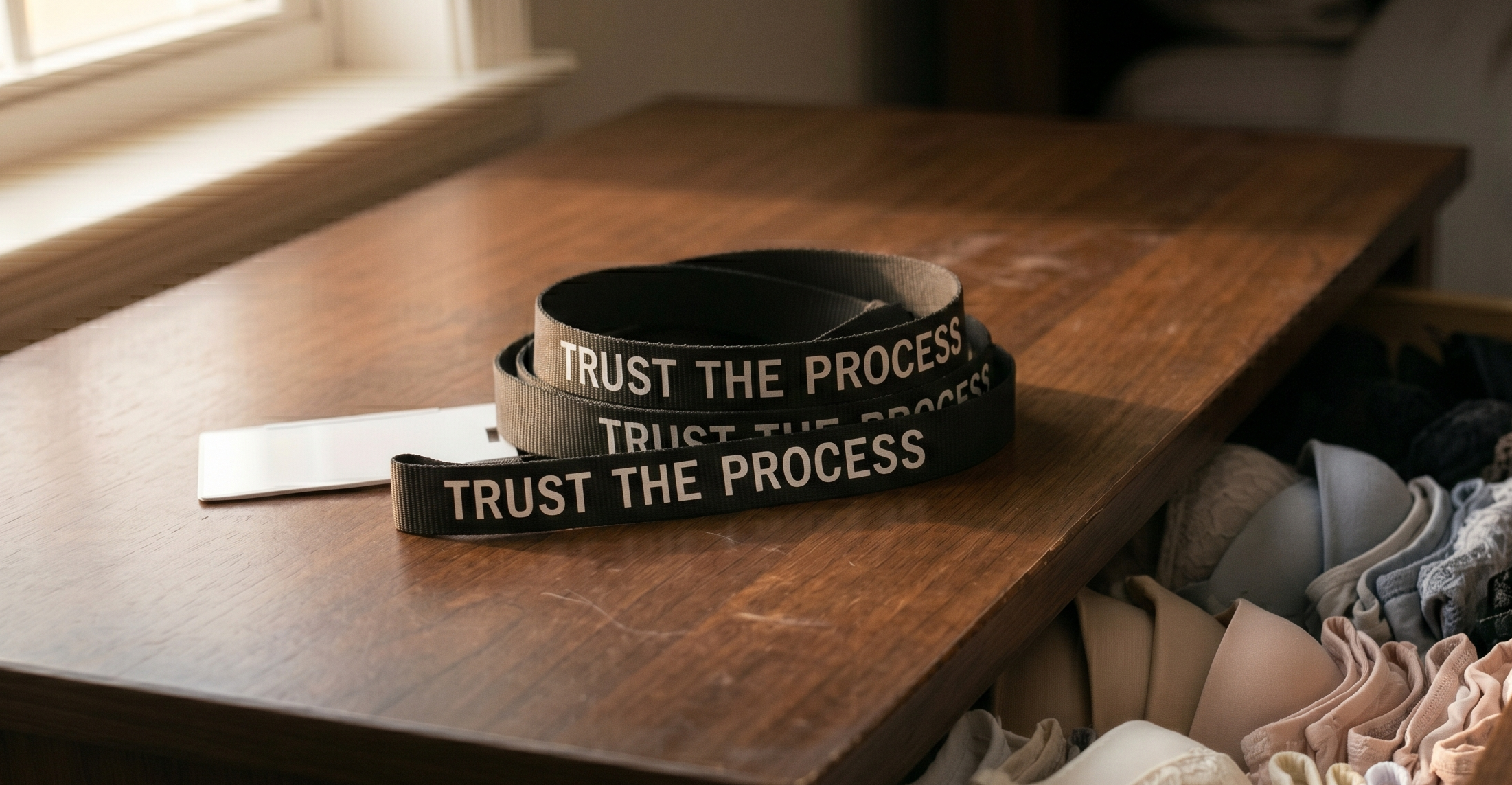
The bag was packed from the night before. She lifted it, settled it on her shoulder. She checked the deadbolt — once, twice, the two precise turns that meant locked — and retrieved the lanyard from the hook by the door. Black fabric, heavy, the words stamped crisp into the weave. She settled it around her neck and smoothed it once with two fingers.
Trust the Process.
She knew what it said.
She stood for a moment in the dark hallway, the way she stood every morning, running the day’s sequence before she moved into it. The briefing at seven. The change control board at nine. The deputy secretary’s staff meeting at two. A full day, ordered and known, every variable accounted for.
She was ready.
She turned to go. Then stopped.
She went back to the bedroom. She did this every morning and every morning she told herself she was checking something — the window latch, the alarm — and every morning that was not what she was doing.
On the nightstand, slightly crooked against the lamp base, sat a shallow dish, and in the dish, flattened and folded once, was a paper coffee sleeve gone soft and gray with age.
She didn’t straighten it. She never straightened it.
She stood in the doorway for a moment looking at it — the one thing in the apartment that was not where it should be, the one variable she had never adjusted, the one error she had decided years ago to keep — and then she turned and walked down the hall and out the door into the Arlington dark.
Behind her the apartment held its order. The medicine cabinet, labels forward, grouped by function, tallest to shortest. The closet, clothes by category, then by color within category, all hangers facing the same direction. The desk drawer, pencils sharpened and aligned.
And on the nightstand, slightly crooked, never moved —
A folded paper sleeve, soft with age, in a dish that held nothing else.
She was always prepared.
She knew where everything was.
Almost everything.
— — —
Ann Deering — Process and Compliance Analyst at VA, and the civil servant who reads the file nobody else bothers to read — is a central character in The Chariot Protocol, a novel where the heroes aren’t spies or soldiers, but the civil servants who run the systems everyone depends on.
© 2026 William C. James. All rights reserved.
One drawer in her apartment has never been organized.
Ann Deering can find anything in the dark — a wallet, a binder tab, a claims file from three months back — except a reason to throw away a folded paper coffee sleeve. The novel is what happens the day “trust the process” stops being enough.
Order Now on AmazonPrefer updates over purchases? Get news on future books and new fiction from the universe.